
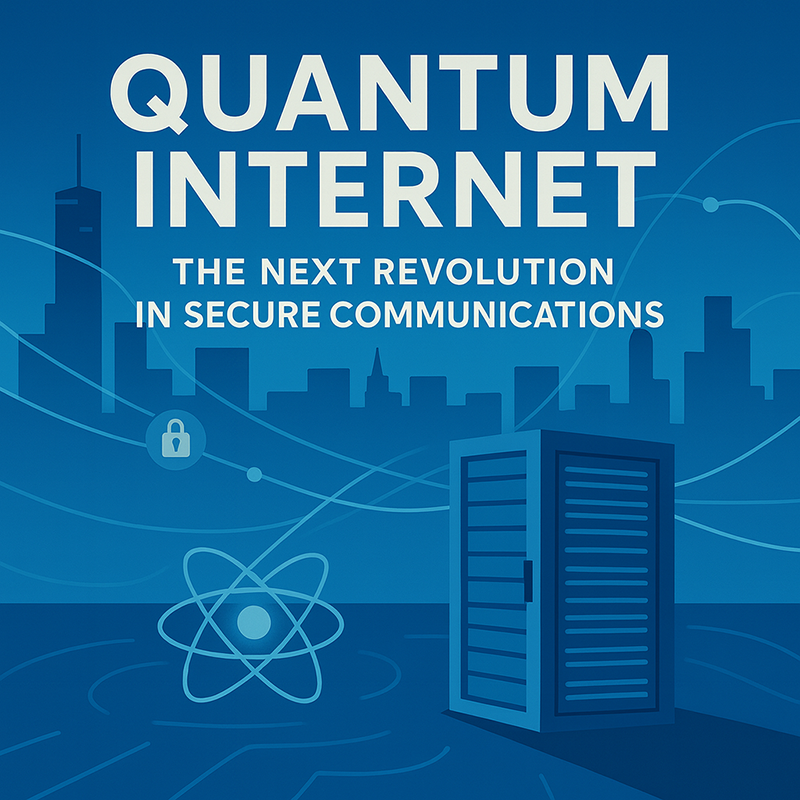
Imagine a world where your private messages are not just safer from hackers, but unbreakably secure. This may sound like fiction, but the idea of completely encrypted messaging is on its way to becoming reality. Thanks to a technology called the quantum internet, scientists believe that within the next 10 to 15 years, we’ll have interconnectivity that’s safe from malware or malicious actors.
While today’s internet is fast and powerful, security remains a global concern. The imminent introduction of a quantum internet aims to change that entirely, bringing in a new era of communication that’s faster, smarter, and nearly impossible to hack.
So what exactly is the quantum internet? And how does it promise to revolutionize the way we communicate? Let’s discuss the possibility of a quantum internet, how it could benefit internet users, and what challenges may be obstructing its completion.
What is the Quantum Internet?
The quantum internet is a new type of network that would use quantum computers to transmit, receive, and secure data. Unlike our regular internet, this emerging one would utilize something called qubits, which can convey complex data through quantum states.
Unlike standard computer bits that represent the numbers 0 or 1, qubits would represent both or neither simultaneously. Often referred to as superposition, this phenomenon could help computers solve complex problems that even large supercomputers struggle with. Due to their intricacies, qubits are still being studied, with the hope that their power can be harnessed for a future quantum internet.
Why Do We Need the Quantum Internet?
Today, we use encryption to protect our online data, such as passwords, bank details, and private messages. However, most of this encryption relies on complex math problems that current computers can’t solve quickly. But the development of quantum computers could change that. These powerful machines could one day crack traditional encryption methods in seconds.
That’s where the quantum internet comes in. It doesn’t rely on tricky math to stay secure. Instead, it leverages the laws of physics and the power of qubits, which could exponentially enhance online security.
How Does the Quantum Internet Work?
One key feature of the quantum internet is something called Quantum Key Distribution (QKD). Unlike traditional encryption methods, QKD employs a unique tactic for detecting malicious actors.
If a hacker tries to intercept your data, the quantum particles would scramble. This is because measuring a quantum system alters the code, which would introduce errors and invalidate the hacker’s attempt at access.
In simple terms: if someone tries to spy on a quantum message, the message could self-destruct. With this powerful technology, using a quantum internet would help keep your messages and data safe.
Real-World Progress Toward a Quantum Internet
This may sound like it’s decades away, but the development of a quantum internet is already underway. Scientists have successfully demonstrated quantum entanglement by shooting particles over long distances using fiber-optic cables and even through satellites.
In 2017, China made headlines by using a satellite called Micius to send quantum-encrypted messages between Beijing and Vienna, establishing a completely secure route for data transfer. Other countries, including the U.S., the Netherlands, and Japan, are also working on building quantum networks utilizing similar technology.
Though a quantum internet may be many years away, scientists around the world have already found successful ways to use quantum physics for encrypted messaging.
Benefits and Uses of the Quantum Internet
So, now that we’ve talked so much about a quantum internet, how would it benefit real, everyday people? What can a quantum internet do for specific industries?
While the quantum internet won’t replace the regular internet for browsing YouTube or streaming movies, it will serve special purposes where security is critical. Some key uses include:
- Military and government communications: A quantum internet could safeguard top-secret information from spying.
- Banking and finance: Protecting money transfers and financial data would improve with encrypted connectivity.
- Healthcare: A quantum internet would be helpful in securing medical records and personal health information.
- Science and research: Scientists may have sensitive data to share with their peers. Quantum internet would be highly beneficial in protecting personal research.
Challenges in Building the Quantum Internet
As exciting as it sounds, building a quantum internet isn’t easy. Quantum particles are delicate and can be easily disrupted by heat, light, or even movement. Although scientists have had success in the past, sending quantum particles over long distances remains a frustrating challenge.
Quantum internet also requires new hardware, advanced technology, and global cooperation to establish the necessary infrastructure. This type of connectivity requires time, investment, and innovation, which has already hindered the internet’s development.
Even with these setbacks, there’s still a possibility that a quantum internet will be created over the next decade. With scientists accruing new information, completing new trials, and finding new solutions every day, there’s a lot to be excited about when it comes to this revolutionary internet prospect.
The Future of the Quantum Internet
The quantum internet is still in its early stages, but it holds enormous promise. It’s not just a faster or better version of what we already have, but a completely new kind of internet, one that uses the strange yet powerful rules of quantum physics to keep our information undoubtedly secured.
As scientists and engineers continue to unlock the secrets of the quantum world, we may be standing at the edge of the next big leap in communication. Now that you’re familiar with what a quantum internet could look like, you will be ready and prepared when it’s finally launched someday. For now, continue encrypting your data and using strong passwords, although your cybersecurity practices may thankfully become obsolete in the near future.