
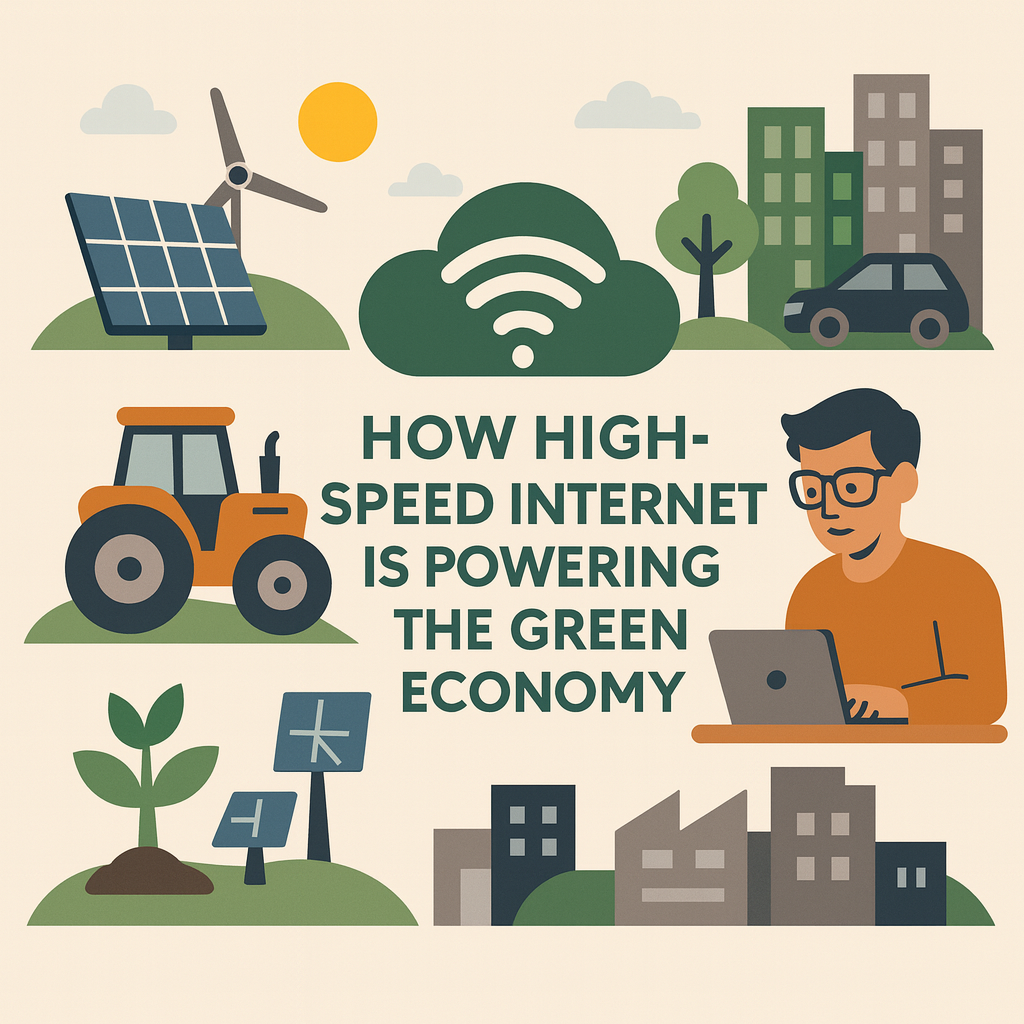
These days, more individuals and companies are adopting sustainable and eco-friendly practices. One unlikely yet powerful driver of the green economy is high-speed internet, which has been responsible for numerous recent innovations. Once seen primarily as a tool for communication and entertainment, fast and reliable connectivity enables entire industries to reduce emissions, conserve resources, and operate more efficiently. From agriculture to smart cities, high-speed internet is helping build a more sustainable future.
So, how is high-speed internet transforming public infrastructure and large companies? Here, we’ll discuss five areas and sectors revolutionizing sustainability through fast connectivity.
Renewable Energy and Smart Grids
High-speed internet is the backbone of modern renewable energy systems and smart grids, which are central to achieving net-zero carbon goals.
Smart grids rely on super-fast communication between energy providers and users. With high-speed internet, utility companies can track electricity usage minute by minute, predict upcoming demand, and automatically reroute energy to reduce waste. This process can streamline the integration of renewable sources, like solar, water, and wind.
Some key impacts of high-speed internet and smart grids are:
- Improved energy efficiency through real-time monitoring and automated systems
- Better integration of residential solar and wind systems into the larger grid
- Reduced energy loss and fewer blackouts through more accurate predictions
Without high-speed internet, these complex grids wouldn’t be able to operate with the responsiveness required to manage clean energy sources at the state or national levels.
Sustainable Agriculture
If you can believe it, farming is also being transformed by high-speed internet. Sometimes referred to as precision agriculture, this method utilizes connected devices, data analytics, and automation to minimize environmental impact while maximizing crop growth.
High-speed internet can facilitate the collection of instant data from complex devices, such as soil sensors, drone cameras, and GPS-guided tractors. This data assists farmers with making precise decisions about water usage, pesticide application, and planting times, dramatically reducing resource waste.
Some sustainability improvements may include:
- Water conservation through smart irrigation systems.
- Reduced chemical usage due to precise pesticide and fertilizer application
- Lower emissions from optimized machinery use
In areas where broadband access is limited, farmers are often excluded from these incredible technological advancements. Expanding high-speed internet to rural regions may be critical not only for economic equity but also for sustainable food production.
Remote Work and Digital Services
One of the most direct ways high-speed internet can contribute to sustainability is by enabling remote working and digital services. Reducing the environmental impact of commuting to the office may be a massive contributor to lowering our collective carbon footprint.
During the COVID-19 pandemic, millions of people began working from home. This resulted in a significant reduction in carbon emissions associated with daily travel and energy use in office buildings. As companies continue to support hybrid or fully remote work models, high-speed internet has become increasingly essential for maintaining productivity, facilitating virtual collaboration, and enhancing sustainability measures.
Remote working can improve sustainability through:
- Lowering the number of vehicles on the road, ultimately reducing car emissions and urban congestion
- Decreasing the energy consumption in commercial buildings.
- Increasing access to virtual services that reduce the need for physical infrastructure and travel.
Remote work isn’t just a perk but a powerful tool for preserving the environment. By leveraging the power of high-speed internet, individuals can rely more on virtual services and reduce their carbon footprint.
Sustainable Manufacturing and Supply Chains
High-speed internet may be a key component to developing smart manufacturing systems that minimize waste, reduce energy use, and increase transparency throughout the supply chain.
With connected sensors and data analytics, factories can more effectively monitor their equipment and identify inefficiencies before they result in substantial, unnecessary energy consumption. Furthermore, companies can track products throughout the entire supply chain, from building to delivery, ensuring sustainability.
By utilizing high-speed internet, companies have more informed insight into their energy usage during the manufacturing process. This type of unprecedented visibility may be the key driver of modern sustainability.
Urban Planning and Smart Cities
The sustainability of urban environments has become increasingly important. With increasing populations, urban planning and development through a sustainability lens is critical to sustainability and overall livability. Modern cities that integrate expansive technology, often referred to as smart cities, utilize high-speed internet and sensor networks to enhance urban life and mitigate environmental impact.
From traffic lights that respond to congestion in real-time to buildings that adjust heating and lighting based on their occupants, smart cities rely on high-speed internet to operate efficiently.
Some key impacts from high-speed internet and smart city collaborations are:
- Reduced emissions from traffic optimization and better transit systems
- Improved waste management and recycling through automated tracking
- Water and energy conservation via smart metering and infrastructure monitoring
Without fast and reliable internet, these advanced systems would be unable to function or scale effectively, negatively impacting overall sustainability.
The Broader Impact of Connectivity and Environmentalism
At first glance, high-speed internet might not seem like a sustainability tool. However, in each of these sectors, fast internet can help improve necessary data analytics, automation, and overall efficiency, ultimately leading to a low-carbon future. By connecting devices, people, and systems, universal connectivity can reduce waste, optimize resources, and drive innovation.
The green economy is not just about electric cars and solar panels anymore; it’s also about integrated technology that can improve our day-to-day lives. High-speed internet is enabling powerful energy grids, precision agriculture, virtual collaboration, and the development of smart cities. It allows industries to operate more efficiently, individuals to make more sustainable choices, and communities to better fight climate change and detrimental carbon emissions.
As we look toward a net-zero future, investment in internet infrastructure should be seen not just as a tech upgrade, but as a fundamental part of preserving our planet. Fast, reliable internet is shaping up to be more than a convenience, but a critical part of environmentalism, urban development, and sustainability.